Google
Showing posts with label Food. Show all posts

Tuesday, July 8, 2008

Day 189- Urban hiking

Day 189- Urban Hiking

Well friends, it has been a month--a whole month since we were last together.

No, I had not forgotten about us. I just needed a wee vacation to get myself all together again.

General Assembly of the Unitarian Universalist Association was in Ft. Lauderdale, Florida and so I took the train down there and then slowly made my way back up via Greyhound.

It gave me a lot of time to see these fair states of ours with a lot of time to think, and read and reflect.

The highlights of my trip were walking around strange cities and seeing what I can find.

Some call this "Urban Hiking" or "Urban Exploring". It is the process of hiking through a city instead of nature. It is one of my favorite hobbies. It is a great way to get to know a city, have some exercise and it is free--or mostly free.

There are two schools of thought when it comes to urban hiking. One is the pre-planned route. Doing a little research of the city beforehand can show preplanned historical walking tours, art crawls, or architectural tours. Boston, for instance, has the Freedom Trail, a historical walking tour of Revolutionary Boston. Washington DC has Heritage Trails sprinkled throughout the city. Philadelphia has a walking tour of the Mural District. Chicago has a walking tour of the Art Loop. Or you can plan your own. Sarah Milstein gives the following advice on planning an Urban Hike for friends:

Plan your route, and — this is going to sound crazy — assume you’ll go a mile or maybe two an hour. With a group, you’ll move a lot more slowly than you expect. We usually aim for about five miles (www.gmap-pedometer.com is good for figuring out distances) and include about six points of interest and two takeout food stops.
The other school of thought is the just-show-up school. That is what I did for my trip through the South. For both Savannah and Columbia, I just showed up. While approaching each city, I would ask my neighbors on the bus if any one could recommend sights in the city to see. I kept a budget of how much I was expecting to spend in each city for food, drinks, and souvenirs. Then, I went to the visitor's center and picked up a map. I would then just walk. I would walk up and down streets looking at buildings, gardens and art galleries. I went to brew pubs to eat and would ask the locals who worked there for highlights. And I would just walk. I saw great things. I read every historical plaque I could find and absorbed the cities.

Some highlights of my trip include:
Paula Deen's Restaurant- The Lady and Sons
The Mercer-William's House from Midnight in the Garden of Good and Evil
The Unitarian Universalist Church of Savannah--Location where Jingle Bells was written
The South Carolina Statehouse and the Vista Arts District
The South Carolina Holocaust Memorial
The Memorial to the inventor of modern day gynecology

After a week of walking and exploring, I burned off 5 lbs from my waistline and took nearly a hundred photos.

It was a great week. And I have urban hiking to thank. So, head out into your city and see what you can discover.

Monday, May 19, 2008

Day 139- Food as Hygiene (Slow Foods)

Day 139- Food As Hygiene (Slow Foods)

Hygiene is not just about making your body smell good. It is about making your body feel good.

So today, our radical hygiene segment is about what you put in your body to feel good.

We all know that a good diet has long term effects on how our bodies feel and react to our environments. But how do we know what to eat that will make us feel good?

The slow foods movement believes the easiest way to discern is by trusting nature. As natural beings, we feel best when our bodies are in tune with our natural surroundings. This does not mean eating "natural foods" but rather foods that resemble nature.

The slow foods movement began about a decade ago in Italy. It is not a list of rules, but rather a philosophy of how to eat.

Simply enough, slow food is seasonal, local and simple.

1. Seasonal--Fruits, vegetables, and meat are all the most healthy when they are prepared according to season. Growing a tomato in winter requires a lot more resources and puts stress on the fruit. Ultimately, out of season fruits and vegetables do not taste good and they are sapped of vitamins and minerals.
2. Local-- Organic is great. I support organic foods a lot. But, if it is grown on a factory farm somewhere on the other side of the continent, hemisphere, or world, and then shipped to you many of the benefits of buying organic foods will be counteracted. Also, buying locally (or growing your own) guarantees that your food is picked at the peak of freshness
3. Simple--Americans have forgotten what food should taste like. Our food is full of sugar and fat and chemicals. But there are few meals as satisfying as a simple dish made with quality items that have complimentary flavors and textures.

With those three guide lines, I give you my philosophy on slow foods. These are the things I try to think about when I think of food.

1. Have a relationship with my food- I love going to my farmer's markets. I love getting to know the people who make my food. I also like growing my food in my garden. By having a relationship with my food, it becomes more than just what I put in my mouth. I become much more in tuned with my food.
2. Try not to eat anything I cannot pronounce- Quick food is convenient. But often it requires all sorts of chemicals I cannot pronounce. And if I cannot pronounce it, it should not be going into my body. Tomato= eat. Monohydrogenated sodium bepotal= do not eat.
3. Four Walls- Sometimes, you do need to go to the grocery store. It is really convenient, especially when you don't have a farmer's market. But think of the layout of the super market. If you go along the four walls, you get the freshest foods. Produce, freshly baked goods, animal protein, dairy all lie along the four walls of the store. When you start moving into the aisles, you start to see things that are not fresh. You see things that are jam packed with chemicals. Although, there is a caveat, there are plenty of good, healthy things in the aisles. For instance, flour, olive oil, frozen veggies, pasta. Just be thoughtful about what you are eating.
4. Avoid anything "all-natural"--Anything that has a label that says "all-natural" is probably an advertising gimmick, especially if it comes from a muti-billion dollar corporation. Really, what would all-natural Ritz crackers really have in them? There is no way to know, and that is not slow foods.

Slow foods is a great philosophy on life, in my opinion. But it does not always work. It is a commitment. And in this go-go gadget world of ours, we cannot always commit to it. As one finds out, it becomes increasingly more difficult in the winter months. But it is worth a try. One may even find it enjoyable and preferable.

And, you also cut down the risk of eating nothing but junk food all day long and then find yourself doubled over and vomiting in front of a night club on 14th St NW. Not that I have any real experience of that at all.

What a coincidence! Both How-To's of the day are on radical hygiene. And one of them is about Slow Foods. It is cosmic, I tell you. Cosmic.

Competency moment: Bought strawberries at Eastern Market (complimented a dollar off each quart saving $4) and made a year's worth of strawberry jam.

Thursday, May 15, 2008

Day 135-Pickles

Day 135- Pickles

As a belated Mother's Day Present, this week's entries are created by request. My mom wants to learn how to make pickles.


To better understand the pickling process--more than just stuff in brine--you have to understand mason jars. Not only that, but working with mason jars can be dangerous if you don't use them properly.

Mason jars were invented in 1884 as a convenient way to store perishables. In a world where there was no refrigeration, one needed a way to keep an air tight seal free of bacteria. Mason jars seemed to have gotten the job done since 124 years later, they are still around.

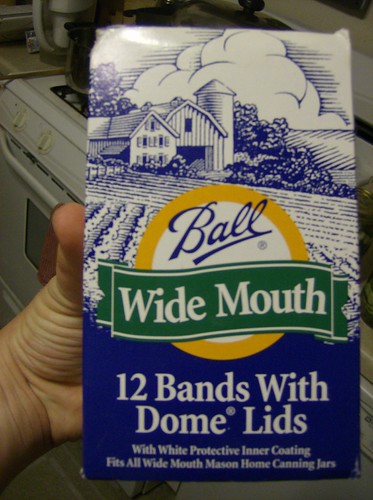
Mason jars have three parts, the glass jar, a metal band, and a metal lid. The jar and band are both reusable, the metal lid is not. The lid has a sealing agent that only works once.

Mason jars are available at most large grocery stores and hardware stores. If you find jars at a thrift store or second hand store inspect them for any large chips or cracks. Those are great spots for bacteria to hide. Lids and bands are available where ever new cans are sold.

Canning does not take a lot of work. But it does take some boiling, which we can cover tomorrow.

After boiling in the cans, any bacteria is killed and the slow fluctuation of temperature causes the hot, expand gasses to condense and create a vacuum, thus preserving your fruits, veggies or sauces.

As for your pickles, you have cleaned and cut your cucumbers, you now need to create a brine.

For your brine, you need:
6 cups of water
2 1/2 cups of vinegar (I use cider or distilled white)
1/2 cup kosher salt

Bring your brine to a boil, and stir until all the salt is dissolved.


In the bottom of your clean mason jars, add one clove of garlic and about a half dozen whole pepper corns.

Proceed to pack your jars with cucumbers until full. Leave about 2 inches of head space in order to make room for the brine. Top with about 2 tablespoons of whole dill weed.

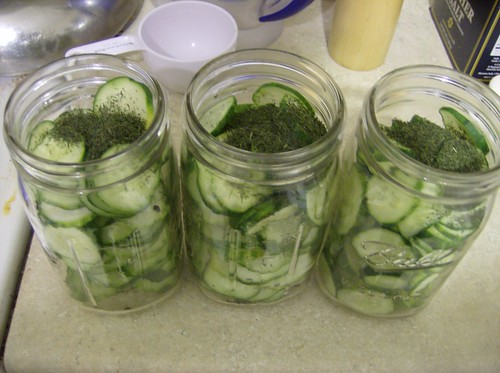
Your jars should look as such:


Here, there are cucumbers packed into clean jars with the pickling spices. You can also purchase pickling spices from Ball or the grocery store, but I like the simplicity of mixing the spices myself.

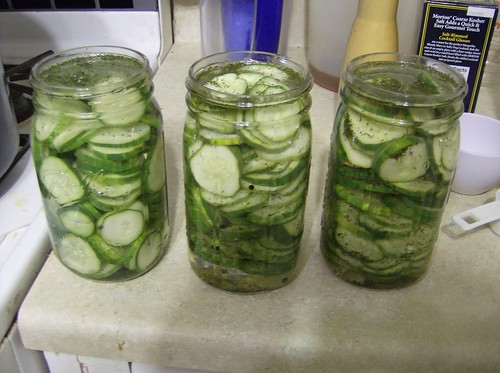
Carefully add the brine to the jars, keeping about an inch of head space at the top. The cucumbers will most likely float. That is ok.

In the photo below, I overfilled the jars. This was before I learned about the importance of head space. Having head space makes it easier to open when you are ready for those delicious pickles.

At this point, make sure any utensils you use to stir or pack are rubber, plastic or wood. Using a metal utensil will run the risk of oxidizing the pickles. Not too appetizing.

Tomorrow, I will explain the actual canning process. It is not too difficult.

Competency moment of the day:
I am sending in the house application for a new house in Columbia Heights. It is a cute house for $1500 less a month. Although we have to lose 2 people, it is going to be a great new home.

Tuesday, May 13, 2008

Day 133- Pickles

Day 133- Pickles Part 1

As a belated Mother's Day Present, this week's entries are created by request. My mom wants to learn how to make pickles.

Spring time is here and as we move into the summer months, we see an amazing array of fresh fruits and veggies. All across America, we have seen the growth of farmer's markets and locally owned green grocers.

I love going to farmer's markets for 3 reasons:
1. Creating a relationship with the people who grow and produce my food.
2. It is guaranteed to be fresh because it is picked and delivered on the spot.
3. Locally and/or organically grown food is better for our environment and economy because we reduce our dependence on petroleum in our growing process.

For the reasons above, I also like pickling and canning my fruits and veggies as they are in the peak of ripeness.

But what exactly is a pickle? A pickle is anything that has be preserved in brine. A brine is a solution of salt, vinegar and water. Beyond those three ingredients, you can have a whole array of brines: dill, sweet, spicy, etc.

This week, I will show you how to make my favorite pickle--the kosher dill pickle. This recipe is easily found all over the Internet. I use the Joy of Cooking's Quick Pickle Recipe.

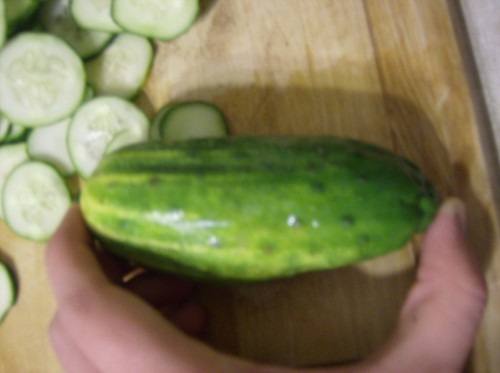
Step 1: Select your cucumbers. In this picture, you can kind of see what we are looking for. Your cucumbers should be about four inches long, have some nice variation of colors. Ideally, you have a good spacing of bumps and smooth areas. The flesh should be firm with a slight give. You want to avoid soft and mushy spots. If they have some pre-cut, you want the center to be firm with tight grouping of seeds and nice, white flesh. Purchase about 4-5 lbs of cucumbers.

Step 2: Wash and slice your cucumbers. Give your cucks a good rinsing. Make sure all the dust and mud is cleaned away. Cut off the ends of the cucumbers and thinly slice. No need to go crazy and bring out the mandolin or anything just a quick slice of the fruit. Now is a good time to get rid of any stray soft spots.

Step 3: Make sure your Mason Jars are clean.

Tomorrow, we will talk about Mason Jars and brine.

Friday, May 2, 2008

Day 122- Fixing Cookign Disasters

Day 122- Fixing Cooking Disasters

At an early age, my dad got me and my brother into the kitchen to help him cook. Since then, I have really enjoyed cooking, which is good. When I became vegetarian, I had to learn how to cook for myself. Since then, I have become the resident cook for our family and one of the resident cooks for our Co-Op.

Cooking your own meals are great. They cost less and are healthier for you and the environment. I know a lot of people--who went through college no less--who swear they cannot cook. I know they are lying though. Every one can make something. Even if it is Kraft Mac and Cheese, you can heat something up. Brian Regan shows how any one can cook.


But here are some helpful tips on getting on the fast track to cooking.

1. Get yourself a good cook book. There are a lot out there. A lot. Seriously, a lot of cook books. But how do you know which one to get? Well, get one that fits you. Make sure you look through it first. Does it have food you would like to eat? Does it look like it is at your skill level?Does it have pictures so you can follow along? Make a day of it at Barnes and Noble's or your local used book store and really read the recipes and the descriptions of things. Some books I can recommend are: The Joy of Cooking, The Betty Crocker Cookbook, Mark Bitteman's How To Cook Everything, and Deborah Madison's Vegetarian Cooking For Everyone. I especially like the Madison book. I read that one like it was a Faulkner.

2. Watch Cooking Shows- Cookbooks--even ones that have pictures--may be able to show you recipes, but they are not stellar at teaching technique. What do "stiff peaks" actually look like? How golden-brown is "golden brown"? Questions like these are best answered in real life. Watching cooking shows is a great way to get the "feel" of cooking. But just a warning-these are professionals who have 20 minutes to cook a meal. They can go fast. You should not. If it is the first time with a recipe, take your time to really learn the recipe. Get used to the sights, sounds, smells, colors and tastes that go into cooking your meal.

3.Taste and Clean As You Go- Whenever I add something to the pan or the pot, I always taste it. Does it need more pepper? More salt? Is it too spicy? What would balance this better? Get to know what things taste like--and how they change in relation to one another. And when I have a moment of down time, I always try to wipe off the counter and move my dirty plates, knives, spoons and bowls into the dishwasher. It makes clean-up easier after the meal.

4. Assess your meals- If you have loads of leftovers that go bad in the back of the fridge, why exactly is that the case? On the other hand, what made is meal so successful that people were disappointed when it ran out? Really try to understand your meals.

5. Learn From Your Mistakes and Try to Avoid Them- Mistakes are bound to happen. That's OK. Maybe you over-spiced your chili (a common mistake for me). Maybe you burnt the bottom of the pot. Maybe your fish is soggy. When you notice your mistakes and learn from them, you can work hard to avoid them next time. Real Simple has a great guide to avoiding common cooking mistakes.

Alright, with these things in mind, you are on your way toward being a competent cook--thus letting you eat more home cooked meals and reducing your reliance on eating out.

Competency Moment of the Week: Our house gave our landlord our 30 days notice. We have also sent in our applications for a wonderful new house with more rooms, more space and less rent. You better believe we will have some moving competency entries coming up.

Also, my mom requested a post on pickles and jams. That will be coming on Wednesday.

Monday, March 10, 2008

Day 69- Back on the Bandwagon

Day 69- Back on the Bandwagon

Last week was crazy! Friday was the Interfaith Peace Witness and because I was working on the planning committee, my whole world was upside down and inside out.

And because my world was a big ball of crazed stress, my finances went super crazy. Instead of packing healthy and delicious lunches, I would eat a burrito the size of my head from Chipotle or something cheap and easy from the deli. Or, just not anything at all.

I have dropped keeping track of what I ate, especially at The Daily Plate. And while it felt good, it also means I don't really remember what I ate or how much I spent on it.

So, the first thing I did this weekend when I was done with the Peace witness was to balance my checkbook from the past week. It was pretty shocking how much I spent on stress food.

But, I am right back on the bandwagon again. And instead of eating out, I have been making all my food again. And with the March Bulk order coming in tonight, I am excited to have food in the house again. And a new batch of farm fresh CSA veggies are on their way in just a few weeks.

So my expenses are in order and food is healthy and fresh.

Competence Moments of the Week: Getting all my finances back into order by balancing my checkbook, updating my automatic debt reduction, and filing my taxes. It looks like I am getting $1,000 back from my Fed alone! (That dosn't even include Indiana, DC taxes or my Stimulus package). And pulling off a bad-ass MoFo of a peace march.